A crown should disappear. It should chew like a natural tooth, look like a natural tooth, and become something you stop noticing within a few weeks. The difference between a crown that achieves that and one that always feels like a foreign object is the attention to detail behind it, the impression, the temporary, the material, the bite, the fit, and the final approval before anything is permanent.
At Slate Dental in Northwest Washington, DC, Dr. John Slate approaches every crown, and every onlay, as a piece of precision restorative work. Whether you are protecting a cracked tooth, replacing a failing older crown, or rebuilding a tooth around an aging amalgam filling, the goal is the same: a restoration that becomes part of you.
The harder right over the easier wrong.
Our Standard of Care
What Attention to Detail Actually Looks Like
Every dentist will tell you they care about quality. The question is what that means in practice. Here is what it means at Slate Dental.
The first impression of a crown appointment is the anesthetic. Dr. Slate uses techniques that make the injection itself comfortable, often imperceptible. You are talked through every step, and nothing happens until you are ready.
The accuracy of your final crown is set by the impression. We use premium impression materials that capture every contour and margin precisely, the foundation that everything else is built on.
Your temporary crown is made by hand in our office, not delegated. Patients regularly tell us their temporary feels so natural they wish they could keep it. We take that as a compliment, and as proof of the standard.
Before your crown is permanently bonded, you see it, feel it, and approve it. If anything is not right, the color, the bite, the shape, we adjust before it becomes permanent. The crown is not finished until you say it is.
How a Pressed Crown Is Actually Made
Most patients have no idea what happens between the impression appointment and the cementation appointment. Here is the process behind a pressed lithium disilicate crown, because the work behind the scenes is the work that determines how the crown turns out.
- The wax-up. The lab takes the model of your prepared tooth and sculpts a wax replica of the ideal final tooth, shape, contour, contact points, bite, all designed to look and function like a natural tooth in your specific mouth.
- Investment. The wax pattern is encased in a heat-resistant investment material. When heated, the wax burns out cleanly, leaving a precise hollow cavity in the exact shape of your future tooth.
- Pressing the ceramic. A lithium disilicate ceramic ingot is then pressed under high heat and pressure into that hollow cavity. The ceramic flows into every contour the wax-up captured, producing a crown that is dense, strong, and shaped to the original ideal anatomy.
- Finishing and characterization. The pressed crown is freed, refined, and hand-characterized for color, translucence, and surface detail to match your surrounding teeth.
The result is a restoration with the strength of pressed ceramic, the translucence of natural enamel, and an anatomy that came from a hand-built ideal, not a generic mill template.
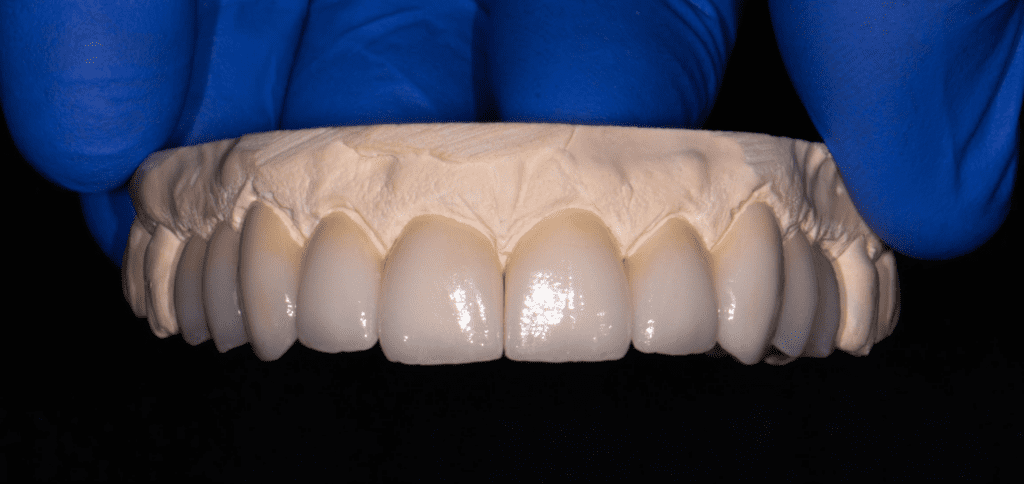
A finished maxillary ceramic crown restoration on the gypsum stone model used to build it, premolar to premolar.
When We Choose an Onlay Instead of a Full Crown
A full crown covers the entire visible surface of a tooth. An onlay is a smaller, more conservative restoration that covers only the damaged portion, often a cracked cusp or a worn-out section around an old filling, while preserving the healthy tooth structure around it. When the tooth allows for it, an onlay is almost always the better choice. Some dentists and labs call this hybrid restoration a “crownlay” — coverage that sits between a filling and a full crown.
This question comes up frequently with patients who have older silver (amalgam) fillings. Amalgam expands and contracts more than the tooth around it over decades of use, which slowly stresses and cracks the surrounding tooth. By the time those cracks become symptomatic, many dentists default straight to a full crown. We will often instead remove the failing amalgam, evaluate the remaining tooth, and place a pressed ceramic onlay that restores only what needs to be restored.
The trade-off is honest: an onlay is technically more demanding than a crown. With less reduction comes less retention and less resistance form for the restoration to hold onto, which requires a higher standard of preparation, impression, and bonding. The reward is that more of your natural tooth stays intact, which matters for the long-term health of the tooth. It is, again, the harder right over the easier wrong.
The same pressed lithium disilicate, the same wax-up-to-pressed-ceramic workflow, and the same in-house temporary and final-approval process apply to onlays. The only difference is how much of the tooth we are conserving in the process.
Pressed Lithium Disilicate vs. Milled Zirconia: How We Choose
There are two main families of modern ceramic crown materials, and an honest patient education means explaining both. Each is excellent in the right situation. The skill is in knowing which to use when.
The ceramic we favor for most crowns. Pressed into hand-built anatomy from a wax-up, with translucence and color stability that closely match natural enamel. The bonding chemistry to natural tooth structure is well-established and reliable over the long term.
Best for: Single-tooth crowns, esthetic zones, anywhere the result needs to disappear into your existing smile.
Extremely strong, typically milled by machine from a solid block. The accuracy is limited by the milling bur, and the bond to natural tooth structure can be more challenging to maintain long-term. Less lifelike in translucence than pressed ceramic.
Best for: Long-span bridges where flexural strength is critical, or implant crowns where porcelain is supported by a metal substructure and fracture resistance matters most.
Both materials are excellent in skilled hands. The reason we favor pressed lithium disilicate for most cases is the combination of esthetics, color stability, and bonding reliability. The reason we use zirconia when we use it is because in specific situations, strength is what the case actually requires. The point is that the material is chosen for your case, not selected by default.
What a Crown or Onlay Is, and When You Need One
A dental crown (sometimes called a “cap”) is a custom-made covering that encases the entire visible surface of a tooth. An onlay is a more conservative version that covers only the damaged portion. Both restore the tooth’s shape, strength, and function, the difference is how much natural tooth structure they preserve.
You might need a crown or onlay for several reasons:
- A severely decayed or broken-down tooth that can no longer support a standard filling
- A cracked or fractured tooth that needs to be held together to prevent further damage
- A tooth weakened or cracking around an old silver (amalgam) filling
- Severe wear from grinding or acid erosion
- Restoration of a dental implant
- Replacement of an older crown that has begun to fail at the margins
If your tooth’s damage extends into the nerve, we will diagnose the issue and refer you to a trusted local endodontist for a root canal. Once the root canal is complete, you return to our office for the final crown.
Getting a Crown in Washington, DC: What to Expect at Slate Dental
- Consultation and exam. Dr. Slate evaluates the tooth, takes necessary imaging, and plans the case, including which material is right for your specific situation.
- Tooth preparation and impression. Dr. Slate gently removes decay and reshapes the tooth, then takes a high-precision impression that will guide every step of the lab work.
- In-office temporary. While your final crown is being crafted, Dr. Slate makes a hand-shaped temporary in the office. It is meant to last a few weeks, but it is built to a higher standard than most patients have ever experienced.
- Final placement, on your approval. At your next visit, the final crown is tried in. You evaluate the fit, the bite, and the look. If anything needs adjustment, we adjust. Only when you are satisfied is the crown permanently bonded.
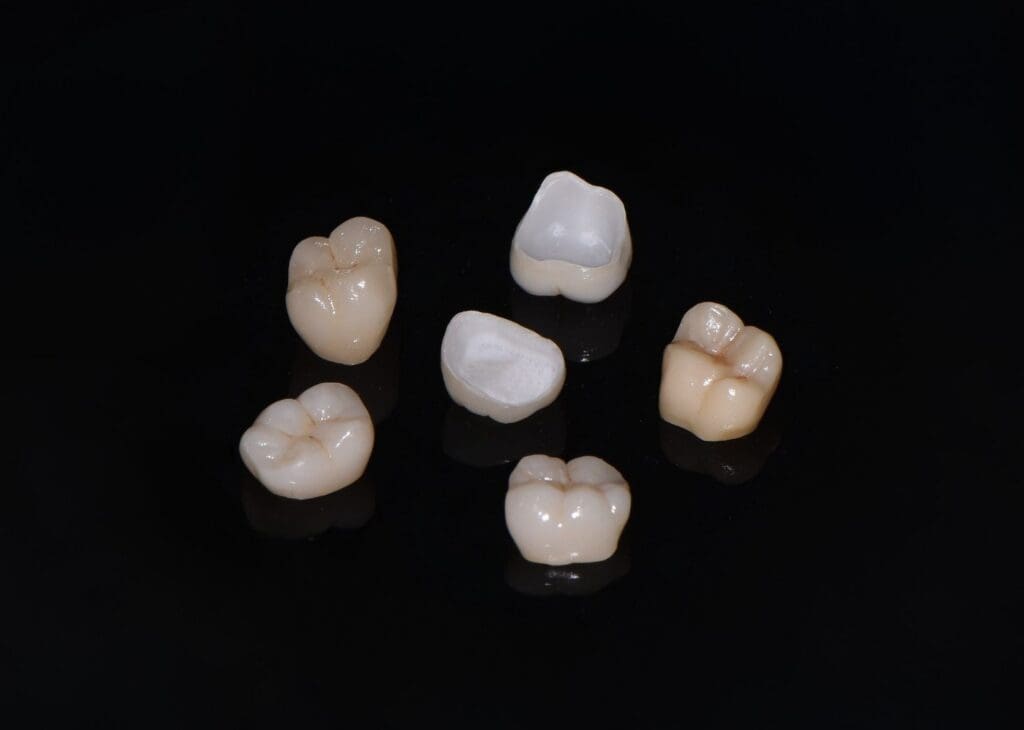
Six finished crowns prior to delivery. The lifelike translucence and surface character are characteristic of pressed lithium disilicate.
Longevity and Aftercare
The American Dental Association cites an average crown lifespan of around 8 to 10 years. Our goal on every case is to exceed that meaningfully, through precise preparation, accurate impressions, premium materials, and careful bite design. While we cannot guarantee any restoration will last a specific number of years, we design every crown to last well past the average.
The crown itself does not decay, but the natural tooth structure underneath still can. Routine brushing, flossing, and regular cleanings keep the margins healthy. If you grind at night, a custom night guard protects your work.
Cost and Planning
Pressed ceramic crowns at Slate Dental start at $2,400, with onlays in a similar range. That places us above typical insurance-network pricing in the area and below what many concierge practices charge — the fee reflects the impression materials, in-house temporaries, master lab work, and unhurried appointment time described on this page. If underlying foundation work (a build-up, for example) is needed first, it is identified and itemized up front. At your consultation, you receive a clear, written treatment plan with transparent pricing, and financing options are available, especially when crowns are part of a larger restorative case.
Honest Answers About Crowns and Onlays in Washington, DC
What is the difference between a crown and an onlay?
A crown covers the entire visible surface of a tooth; an onlay covers only the damaged portion and preserves the healthy structure around it. When the tooth allows for it, we favor the onlay — it is more technically demanding to do well, but more of your natural tooth stays intact.
How much does a dental crown cost in Washington, DC?
Pressed ceramic crowns at Slate Dental start at $2,400, with onlays in a similar range. For context, insurance-network practices in the area are often in the $1,000–$2,000 range, while many concierge offices in DC charge more than we do. Any foundation work is itemized transparently at your consultation, and financing options are available.
How long does a crown last?
The American Dental Association cites an average crown lifespan of around 8 to 10 years. We design every crown — the preparation, impression, material, and bite — to last well past that average, though no restoration can be guaranteed for a specific number of years.
Does getting a crown hurt?
It should not. The anesthetic technique matters most: Dr. Slate uses injection methods that are comfortable and often imperceptible, and nothing proceeds until you are fully numb and ready.
How many visits does a crown take?
Two. The first visit covers preparation and a high-precision impression, and you leave with a hand-shaped temporary made in our office. A few weeks later, the final crown is tried in, adjusted if needed, and bonded only after you approve the fit, bite, and look.
The Slate Dental Difference
Schedule a Crown or Onlay Consultation
Whether you are restoring a single tooth, replacing an older crown, or planning a larger case, the quality of the restoration is what you live with every day. We would be glad to discuss whether a crown, an onlay, or a different approach is right for you.
Or call (202) 686-5222. We serve patients throughout Northwest DC, including Georgetown, Forest Hills, Wesley Heights, and Spring Valley.