
Aging or failing teeth do not always need to be replaced with dentures. At Slate Dental, Dr. John Slate takes a foundation-first approach to complex restorative dental care. Whether you are dealing with worn enamel, a collapsing bite, or missing teeth, the goal is to rebuild your mouth’s structural integrity — and wherever the foundation allows it, to do that with fixed restorations that let you eat, speak, and smile the way natural teeth do.

Last reviewed: August 12th, 2026
Already been given a plan somewhere else?
Most people who end up here have already been told something — that they need dentures, that a tooth is hopeless, or that they need a large amount of work they were not expecting. Start there. Bring the plan and the radiographs. Dr. Slate will examine the foundation, tell you honestly whether a fixed reconstruction is possible, and tell you just as honestly when the plan you were given is the right one.
That is a much smaller first step than committing to a reconstruction, and it is how most of our complex cases begin. More about second opinions.
What Full Mouth Reconstruction Actually Means
The term covers a wide range. At its simplest it means restoring most or all of the teeth in a coordinated plan rather than one at a time. What makes it reconstruction rather than a series of crowns is that the bite itself is being rebuilt — the way the teeth meet, the height of the lower face, and the position the jaw closes into are all being deliberately re-established rather than accepted as they currently are.
That distinction matters enormously for how the case is planned. Restoring twenty teeth to the bite you already have is a large job, but a straightforward one. Restoring twenty teeth and changing where the bite sits requires the whole thing to be designed before any tooth is prepared, tested in something removable, confirmed comfortable, and only then made permanent.
How We Determine Where the Bite Should Sit
Vertical dimension — the height of your lower face when your teeth meet — is the part of a reconstruction that is easiest to get wrong and hardest to undo. Open a bite by an arbitrary amount and the restorations spend their entire service life fighting the way the patient actually functions.
We determine it from function rather than from a number. The lower central incisors are mocked up first, and you speak and function in them. The path your jaw genuinely travels through — its envelope of function — is what dictates where those incisal edges can live. Once the lower incisal edge position has been established by real movement, the vertical dimension and the anterior guidance follow from it rather than being imposed on it.
It is a slower way to arrive at the answer, and in our view the most reliable one available. Every other decision in the reconstruction is built on top of this one, which is why it happens before anything is prepared.
Is Full Mouth Reconstruction Right For You?
Most of the patients we treat this way want to keep their own teeth, or replace them with something fixed rather than removable. The situations we see most:
- Severe wear: Teeth that look visibly shorter or flat from years of grinding or acid erosion.
- Repeated breakdown: Chipping, cracking, or fracturing that keeps happening, usually around large old restorations.
- Missing teeth: You have lost teeth and do not want a removable denture.
- A collapsing bite: Your jaw position feels like it has shifted, or your face looks shorter than it used to.
- A mouth full of aging dentistry: Crowns and fillings from decades ago, all reaching the end of their service life at once.
If you are not sure which of these describes you, our guide to dental symptoms walks through what different signs usually mean.
How a Case Actually Runs
The part almost no practice explains is what happens between the consultation and the finished result. A reconstruction is not a single long appointment — it is a sequence, and most of the decisions that determine the outcome are made before anything permanent is done.
- Records and diagnosis. A comprehensive examination, full radiographs, photographs, impressions, and bite records. We document every existing tooth and restoration, the condition of the gum and bone supporting them, and how your jaw actually closes. Nothing is planned from an impression alone.
- The blueprint. Your models are mounted on an articulator using a facebow record, so the case can be studied and designed outside your mouth in the same spatial relationship your jaw actually works in. The finished result is then sculpted in wax before a single tooth is touched. This is where the shape, length, and bite of the final restorations are decided. Everything after this step is executing a plan rather than improvising one.
- Review, together. You see the plan, the sequence, and the cost of every appointment in writing before anything begins. Large cases can often be phased over time — we will tell you what genuinely must happen together and what can reasonably wait.
- Foundation first. Gum health, any needed root canal treatment, extractions, and implant placement happen before restorative work starts. Surgical procedures go to the specialists we work with. There is no point building on a foundation that is not sound.
- Provisionals — the test drive. You wear a full set of temporary restorations built to the blueprint. Three weeks is the minimum. Where the plan involves implant integration, a sinus lift, extraction site healing, or graft maturation, the provisional phase can run considerably longer — up to a year. That is not lost time. Throughout it you are functioning in a designed, deliberate set of teeth rather than waiting in a compromised one.
- Definitive restorations. Once the provisionals have proven the design, the final restorations are made to copy them. Delivered in stages rather than all at once, and adjusted until you approve fit, bite, and appearance.
The Test Drive
This is the single most reassuring part of the process, and almost nobody explains it, so it is worth being specific.
Before any permanent restoration is made, you wear the new design in provisionals. Not rough temporaries meant to survive two weeks — a hand-built set that reproduces the planned shape, length, and bite. You take them home. You eat with them. You speak, you smile, you see them in photographs, and other people see them.
If something is not right, that is exactly what this phase is for. Teeth too long, a bite that feels off, a sound that has changed when you say certain words, an appearance you are not sure about — all of it gets adjusted in something reversible. When the provisionals are right, they become the template the final restorations are copied from.
The practical consequence: by the time anything permanent is bonded, you already know what it will look like and feel like, because you have been living with it. You are not approving a plan on paper. You are approving something you have already worn.
How long this phase lasts depends on your case. Three weeks is the minimum. When the plan involves implants integrating, a sinus lift, an extraction site healing, or a graft maturing, it can extend to a year — because biology sets that timeline, not us. Patients sometimes hear “a year in temporaries” and picture a year of compromise. It is the opposite: a year in a carefully designed, comfortable, fully functional set of teeth while the foundation underneath becomes ready to support the final result.
Materials, Chosen Tooth by Tooth
On a single crown, material selection is one decision. On a full reconstruction it is twenty of them, and they are not all the same answer.
We keep four materials in regular use and select among them per tooth:
- Pressed lithium disilicate (GC Initial LiSi Press) — our default. Pressed into hand-built anatomy from the wax-up, with the translucence and colour stability of natural enamel. Anywhere the result has to be invisible.
- Cast gold — the longest clinical service record of any restorative material, the least tooth reduction required, and wear behaviour close to natural enamel so it does not grind down the tooth opposing it. On back teeth nobody sees, frequently the best available answer.
- Zirconia — where there is not enough vertical room to give a ceramic crown the thickness it needs, and our standard for implant crowns.
- Porcelain-fused-to-metal — where a margin sits below the gumline and a metal collar seals it more predictably than an all-ceramic edge.
Every one of them is a precision laboratory restoration. None is a budget option. The point of keeping four in play is that a reconstruction spans teeth with genuinely different demands, and defaulting all of them to one material means some teeth get the wrong one. [[LAB_NAME]]
Detail on each is on our crowns and onlays page.
What to Expect at the First Visit
Before starting any treatment, a thorough oral health assessment is essential. As part of the comprehensive examination we interview each patient to understand the type of care they are looking for and review their past dental history.
We record all existing teeth and their past treatments, the status of the supporting structures (gum and bone), and identify any problem areas. We take radiographs, diagnostic impressions, and photographs. All of this data allows us to build a treatment plan that meets your needs and expectations, restoring your mouth to full form and function.
The comprehensive examination (D0150) is $162 and runs 60 to 90 minutes. A full mouth series of radiographs (D0210) is $219 when new images are needed — a series taken elsewhere within the past five years can usually be transferred instead. Diagnostic casts (D0470) are $260 when a case requires them. Details on new patient information.
“The best, most meticulous, caring, attention-paying, painless dental care I have received in my 75 years of caring for my teeth.”
— Slate Dental Patient, Washington D.C.
Real Patient Results: Complex Reconstruction
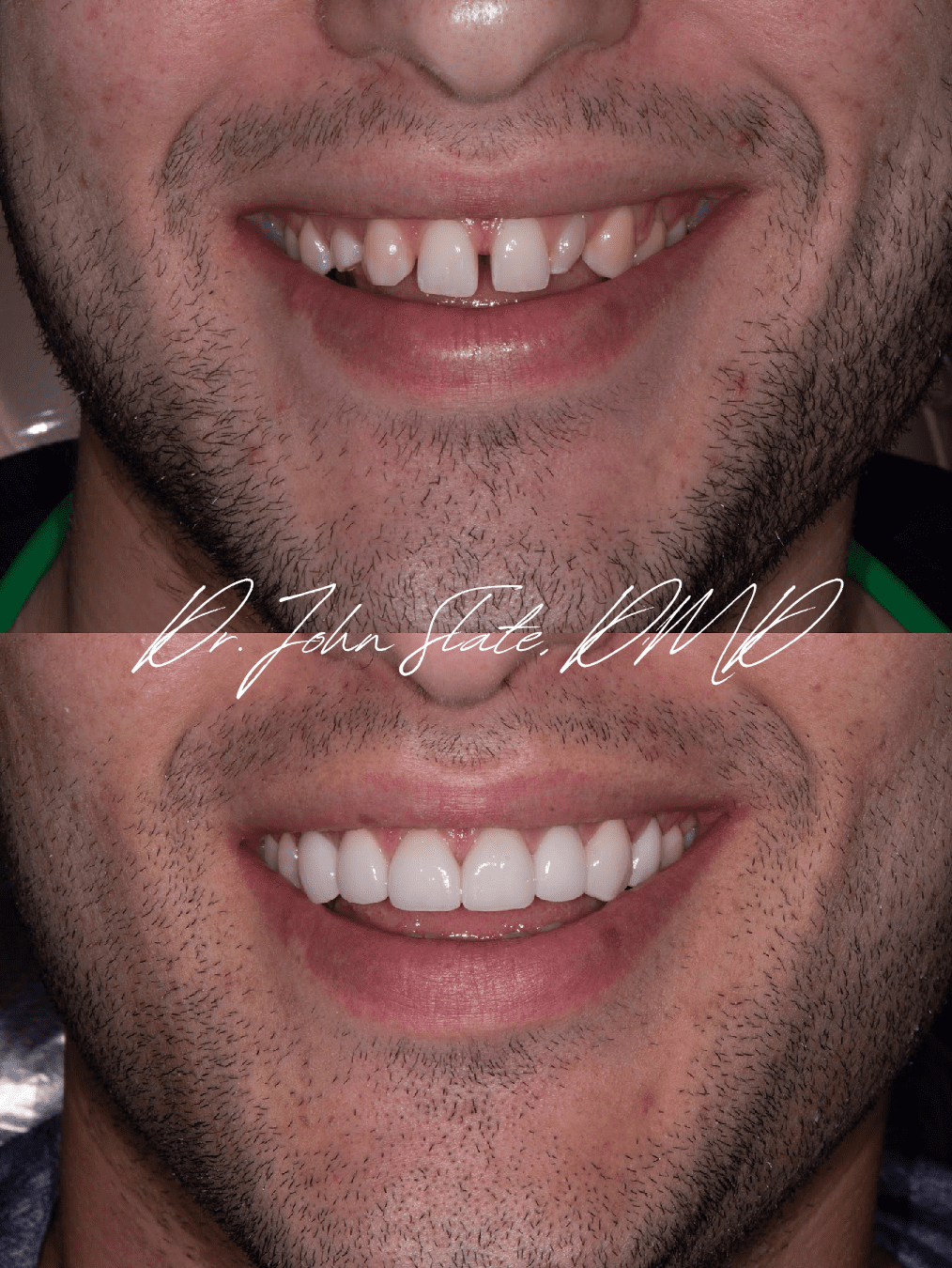
The Challenge: Congenitally Missing Teeth & Spacing
This patient presented with a complex mix of spacing and structural issues: a retained primary (baby) tooth “C,” an adult canine erupting in the lateral incisor position (#6 in the #7 spot), and a “peg” lateral incisor (#10) that was too small and hollow to support a crown.
The Solution:
We executed a precise “Canine Substitution,” reshaping his large adult canine to read as a delicate lateral incisor. The compromised peg lateral was removed and the site restored with an implant, placed by a surgical colleague and restored here. Strategically, we used the natural gaps (diastemas) to widen his teeth, achieving the “Golden Proportion” (80% width-to-length ratio). Before finalizing the case, we used custom temporaries to test drive the new shapes and confirm they followed his natural lip line.
*Actual patient of Dr. John Slate. Results may vary based on individual oral health.
What a Reconstruction Can Involve
Depending on your case, Dr. Slate may combine several of these:
- Crowns and onlays: The core of most reconstructions. Onlays wherever the tooth allows something more conservative than full coverage.
- Implant restorations: Fixed replacement for missing teeth. Surgical placement is performed by an oral surgeon or periodontist we work with; we plan the case and make the final restoration.
- Bridges: Where a fixed span is a better answer than an implant.
- Periodontal therapy: Treating gum disease before restorative work begins. Restorations built on an inflamed foundation fail at the margins.
- Porcelain veneers: Where front teeth need reshaping but not full coverage.
- Referred procedures: Root canal treatment, surgical implant placement, periodontal surgery, and orthodontics all go to specialists. We coordinate the sequence and handle the restorative work that follows.
When We Recommend Against It
Not every mouth needs a full reconstruction, and recommending one when it is not warranted is the most expensive mistake in dentistry.
We will tell you to wait, or to do less, when the wear is stable and not progressing, when the problem is confined to a few teeth that can be addressed individually, when active gum disease needs treating and monitoring before anything is built, or when what you actually want is a cosmetic change to your front teeth and the back of your mouth is healthy. In that last case, veneers or bonding will get you there for a fraction of the cost and a fraction of the tooth structure.
We will also tell you honestly when a removable option is genuinely the right answer. Our preference for fixed restorations is strong, but it is a preference, not a rule — and some foundations will not support one.
What It Costs
A reconstruction is a significant investment, and the honest answer is that the range is wide because the cases are. Here is the actual structure, which is more than almost any practice will put in writing.
| Tooth-borne restorations Crowns and onlays on your natural teeth — the core of most reconstructions |
$2,400 per tooth |
| Implant-supported restorations Crown fee plus a custom abutment; surgical placement billed separately by the surgeon |
Crown + abutment |
| A true full mouth reconstruction Typical total range; the most extensive cases can exceed it |
$20,000 – $70,000 |
| Implant overdenture Removable, but implant-retained and far more stable than a conventional denture |
around $16,000 |
| Fixed implant hybrid A full arch, fixed in place, not removed by the patient |
$50,000 – $60,000 |
Fees current as of August 2026 and subject to change. These figures are typical ranges published to help you plan, not a quote — every case is different, and your actual fee is established after a comprehensive examination and given to you in writing before treatment begins. Foundation work such as periodontal therapy, build-ups, and referred surgical procedures is identified and itemized separately. Surgical implant placement is billed directly by the surgeon and is not included above.
What the restorative fee covers: the diagnostic phase and the mounted wax-up blueprint, the provisional set you test drive, master laboratory work on every unit, the appointment time to deliver and adjust it properly, and the follow-up visits to confirm the bite has settled where it was designed to.
You receive a written plan listing the exact fee for every appointment before treatment starts. Many cases can be phased over months or years, and financing options are available. We file insurance claims on your behalf, though it is worth knowing going in that most dental plan annual maximums have not meaningfully increased in roughly fifty years — a reconstruction of any size will exceed yours.
The Hidden Cost of Waiting
Many patients delay full mouth rehabilitation because their current pain is manageable, the financial burden feels overwhelming, or the process simply sounds too complex to deal with right now. We understand these hurdles and will do everything to help you overcome them. However, dental issues rarely stay static; they compound over time.
- The closing window of opportunity: Delaying treatment often limits our ability to use conservative measures. A tooth that could be saved today may require extraction next year. As time passes, the treatment plan inevitably becomes more aggressive and complex to achieve the same goals. Treating sooner allows us to be as conservative as possible.
- Bone atrophy: Your jawbone relies on stimulation from your teeth to maintain its density. When a missing tooth site is left unfilled, the bone in that area begins to atrophy. Addressing this early prevents the need for extensive bone grafting surgeries in the future.
The Concierge Experience at Foxhall Square
We understand that navigating Washington, D.C. for appointments can be stressful. We have removed that stress entirely.
- Valet & covered parking: Foxhall Square offers an easy-access garage with valet services, so you never have to circle for a spot.
- Elevator access: Our office is fully accessible with elevators directly from the lobby and garage levels.
- Unhurried atmosphere: Our reception area is a quiet, private space. You will not find a crowded waiting room, as we reserve specific blocks of time exclusively for you.
- Early appointments: We open at 7:30 AM Monday through Friday, which means most reconstruction appointments can happen before the workday.
Why Patients Choose Dr. Slate for Complex Care
Rebuilding a smile is a significant investment of time and resources. You deserve a provider who invests just as much in you.
- One patient at a time: We do not double-book. When you are in the chair, you have Dr. Slate’s undivided attention for your entire appointment.
- Direct doctor access: Our reconstruction patients are given Dr. Slate’s personal cell phone number for direct access throughout their treatment.
- A fixed philosophy: We work to save teeth and to use fixed restorations wherever the foundation allows. We will not push you toward a removable denture when a stable fixed solution is viable.
- The plan comes before the drill: Nothing permanent happens until the design has been built in wax, tested in provisionals, and approved by you.
Frequently Asked Questions
How long does a full mouth reconstruction take?
It depends entirely on the complexity of your case. For tooth-borne dentistry — where we use the healthy part of your natural teeth to rebuild from the foundation up — there is often no healing time required at all. If your plan requires orthodontic therapy, surgery, or root canal treatment, those specialty procedures come first and extend the timeline. We can always adapt the sequence to fit your schedule.
How long will my results last?
There is no exact answer, but Dr. Slate designs every treatment plan with the goal of lasting two decades or more. Longevity is largely dictated by home care: patients who maintain excellent hygiene and return for regular preventive visits do considerably better than those who do not. No restoration can be guaranteed for a specific number of years.
How much does a full mouth reconstruction cost in Washington, DC?
Tooth-borne crowns and onlays are $2,400 per tooth; implant-supported units add a custom abutment fee on top of the crown. A true full mouth reconstruction typically totals between $20,000 and $70,000, with the most extensive cases exceeding that. An implant overdenture is around $16,000, and a fixed implant hybrid arch runs $50,000 to $60,000. You receive a written plan with the exact fee for every appointment before treatment begins.
How long will I be in temporaries?
Three weeks is the minimum. If the plan involves implants integrating, a sinus lift, an extraction site healing, or a graft maturing, the provisional phase can extend up to a year, because biology sets that timeline. Throughout it you are functioning in a deliberately designed, comfortable set of teeth rather than waiting in a compromised one.
Will I be without teeth at any point?
No. You wear provisional restorations throughout the treatment phase — a full set, built to the planned design. You will not go through this process with gaps or without teeth.
Can the treatment be broken into stages?
Frequently, yes. Some elements genuinely need to happen together, particularly when the bite is being changed. Others can be phased over months or years. At your consultation we will tell you which is which, so you can plan around both your schedule and your budget.
Do you place the implants yourself?
No. Surgical placement is performed by an oral surgeon or periodontist we work with and trust. Dr. Slate plans the case, determines where implants need to go for the restoration to work, and makes the final crowns or bridges using manufacturer-direct custom components.
What if I have been told I need dentures?
Get a second opinion before agreeing to anything permanent. Sometimes dentures genuinely are the right answer, and we will say so. But “your teeth are hopeless” is a conclusion that depends heavily on who is evaluating them and what techniques they are comfortable with. Bring the plan you were given and we will review it honestly.
Told You Need Dentures? Get a Second Opinion.
If you have been told that your only option is a removable denture, or if you are overwhelmed by a complex treatment plan from another office, we invite you to schedule a comprehensive examination.
Dr. Slate will review your case, examine the foundation of your teeth, and give you an honest assessment of whether a fixed, permanent restoration is possible. Read more about how we handle second opinions.
Or call (202) 686-5222. The American College of Prosthodontists publishes patient guidance on full mouth rehabilitation and what to ask before beginning.