Signature Pressed Porcelain Restorations | Starting at $2,400 per tooth
Porcelain veneers are one of the most precise tools in modern cosmetic dentistry, and in a city with as many cosmetic dentists as Washington, DC, one of the most overused. A veneer is the right answer when a patient’s teeth are already in the right position, the bite is stable, and there is a specific cosmetic limitation that whitening or bonding cannot resolve. For everyone else, the honest first conversation is usually about whether a less invasive option, or a different order of treatment, would serve them better.
At Slate Dental in Northwest Washington, DC, Dr. John Slate takes a conservative approach to veneers, the same approach we take everywhere else in the practice. Veneers are an irreversible procedure on otherwise healthy teeth, and that decision deserves real care.
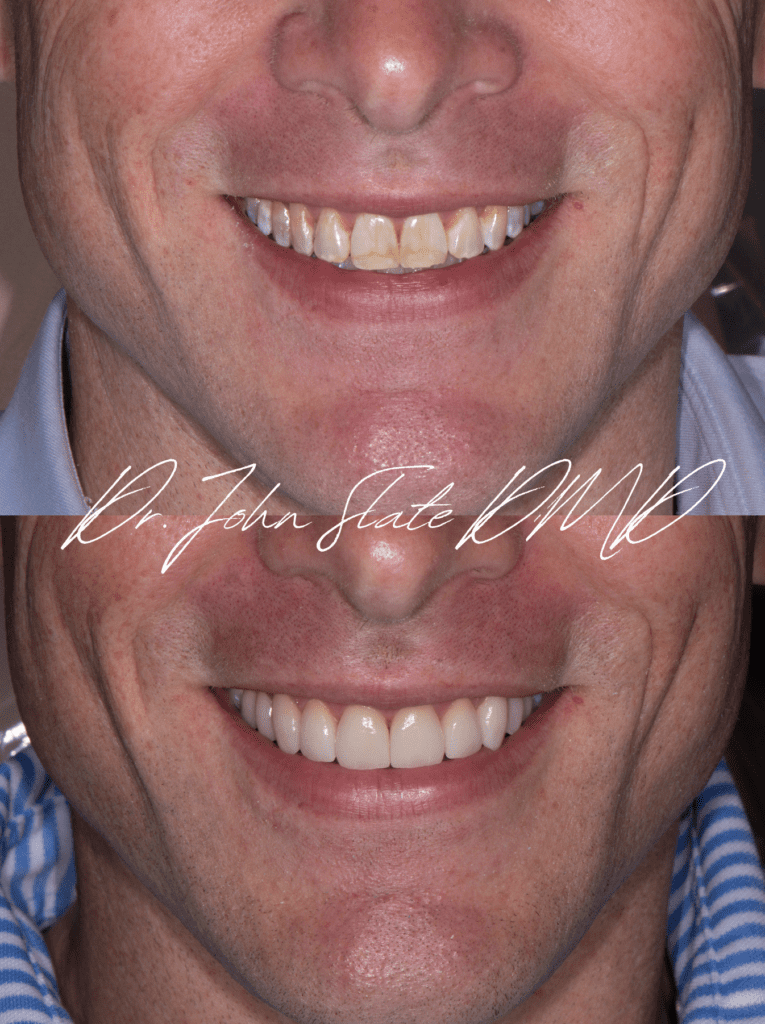
Real patient result: developmental discoloration corrected with hand-layered pressed porcelain veneers.
Veneers are the right answer when other things are already right.
Conservative Cosmetic Dentistry
When Veneers Are the Right Answer
Veneers work best for patients who have a stable foundation: teeth that are already well-aligned (often after orthodontics, with retainers worn consistently), a healthy bite that does not cause excessive wear, and a specific cosmetic issue that other treatments cannot solve. For those patients, veneers can be transformative.
- Deep intrinsic discoloration that whitening cannot lift
- Worn, chipped, or shortened edges from years of use
- Small gaps (diastemas) on otherwise aligned teeth
- Mild irregularities in shape on already-straight teeth
- Patients with stable bites and consistent retainer wear
- Untreated misalignment, orthodontics is usually the better first step
- Active grinding or an unstable bite that has not been addressed
- A tooth with significant structural damage, where a crown is more appropriate than a veneer
- Patients who want results before any underlying issues are resolved
The case for veneers is strongest when the rest of the picture is already stable. Putting veneers on top of an unresolved problem rarely solves the problem, and it often creates new ones.
Veneer or Crown? Occlusion Decides
A veneer covers only the front surface of a tooth. A crown covers the entire tooth. The difference matters because of how forces travel through your bite. If a tooth carries significant occlusal load, the forces of chewing and contact with the opposing teeth, a veneer can be vulnerable on its own; a crown is often the more durable choice. If a tooth is primarily in the cosmetic zone with minimal bite force, a veneer is the more conservative option.
This is the kind of decision we work through case by case. Same general principle as our work on crowns and onlays: choose the most conservative restoration the bite can support, not the largest restoration we could fit.
Restoring Architecture, Not Just Appearance
When teeth are worn, shortened, or chipped, the aesthetic change is usually the symptom of an underlying functional shift, often a gradual loss of vertical dimension or an unstable envelope of motion. True cosmetic longevity relies on structural engineering, not cosmetic masking.
We do not simply bond ceramic to the front of a tooth to hide discoloration. Our diagnostic framework begins by identifying the exact position of the incisal edge across all three planes of space. As the absolute center of your smile, this singular micro-metric position dictates your tooth display at rest or repose, your presentation at full smile, lip positioning, the dynamic Smile Arc, and how naturally the teeth mimic the vermillion border of your lower lip.
By respecting the biological boundary of the DEJ (Dentin Enamel Junction) and mapping how the gingival margins determine your frame, we ensure your smile fits seamlessly within your natural features. The lips are the curtains to the stage, pulling back at varying degrees for every individual. Engineering a Signature bite means your smile does not just look perfect in a static photograph, it belongs perfectly within those moving curtains, protected from flexural fatigue and premature structural failure.
What We Use, and Why
We use a pressed lithium disilicate ceramic (GC LiSi Press) for our veneers. It is a member of the same broader material family as e.max, another lithium disilicate ceramic many cosmetic dentists work with successfully. We chose LiSi Press for three specific reasons:
- Color stability under varied lighting. Lithium disilicate ceramics in this category hold their color well under different light conditions, indoor incandescent, daylight, restaurant lighting, without looking flat or off.
- Translucency that resembles natural enamel. The material reflects light in a way that closely matches the optical behavior of healthy tooth structure, which is what creates the “alive” look rather than a manufactured one.
- Compatibility with hand-layering. A pressed ceramic core lets a skilled ceramist hand-layer additional porcelain for surface character, the subtle differences in shade and translucence that make a smile look real.
The material matters, but it is not the whole story. The result depends just as much on the diagnosis, the design, the preparation, the bond, and the ceramist’s hand. We work with master ceramists who hand-layer rather than rely on stock translucency.
For an overview of the broader category of cosmetic ceramic restorations, the American Academy of Cosmetic Dentistry is a good patient resource.
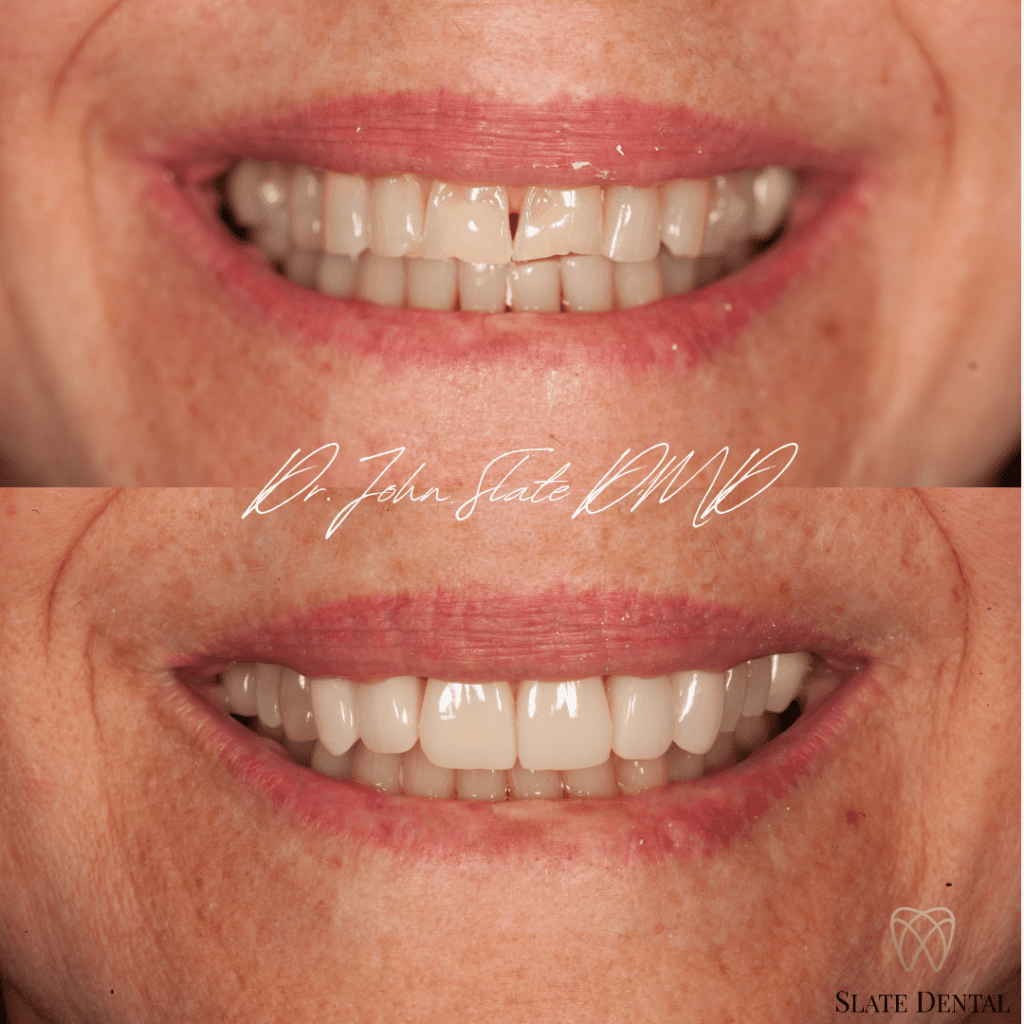
Real patient result: tooth length and shape restored after years of structural wear.
Our Five-Step Blueprint Protocol
Veneers are an irreversible procedure on healthy teeth. Because of that, we use a disciplined, multi-stage process that lets you see and feel the result before any permanent change is made.
We take traditional physical impressions to capture the finest detail of your teeth, gum line, and bite. A gypsum stone model is created and digitally scanned, giving us a precise physical and digital foundation to design from.
Before any tooth is touched, we layer a temporary resin material over your existing teeth in the shape of the proposed veneers. You see your future smile in the mirror, watch it move with your speech, and see how it works with your face. We adjust the design before anything becomes permanent.
When you approve the design, we prepare the teeth, removing only a thin layer of enamel, enough to allow the veneer to sit naturally without looking bulky. This step is irreversible, which is why Step 2 is so important. We then place high-quality temporaries to wear home.
You wear the prototypes home for a real-world test, eating, speaking, photographing your smile. You return for a re-evaluation and we capture any adjustments. The master ceramist replicates not just the look but the bite you have adapted to.
The final pressed porcelain veneers arrive from the lab. Dr. Slate removes the prototypes, tries in the final restorations, and confirms fit, bite, and esthetics with you before anything is bonded. Only when you approve do we proceed to permanent placement.
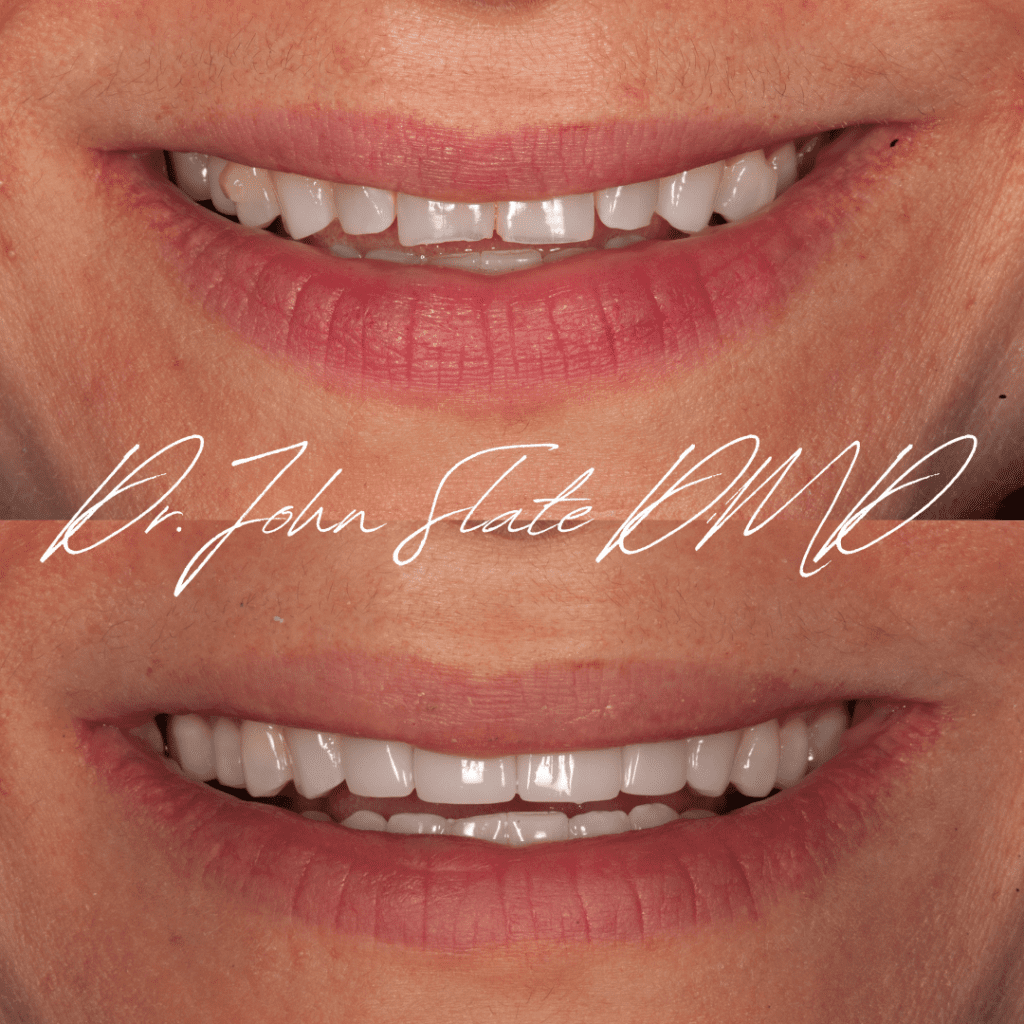
Real patient result: discoloration, chipping, and uneven edges corrected with pressed porcelain veneers.
Honest Answers About Veneers in Washington, DC.
Are veneers reversible?
No. Once enamel has been removed, the tooth will always need some form of restoration. This is why we are deliberate about candidacy, why Step 2 (the mock-up) exists before anything is irreversible, and why we are honest if veneers are not the right step for you.
Will my veneers ever stain or discolor?
Porcelain itself is highly stain-resistant. Over many years, the bonding cement at the margins and the surrounding natural teeth can change subtly with age and habits like coffee or red wine. The veneers will not yellow the way a natural tooth might, but the overall picture evolves with you.
Can veneers chip or break?
Yes. Porcelain is strong but not indestructible. Habits that would chip a natural tooth, biting ice, opening packages with your teeth, untreated grinding, can chip a veneer. If you grind, a custom night guard is part of protecting the work.
How long do veneers last?
With good care, well-made porcelain veneers commonly last well over a decade and often much longer. Longevity depends on the bite, oral hygiene, and habits. We design every case with long-term durability in mind, not just immediate appearance.
What does it cost?
Pressed lithium disilicate veneers at Slate Dental start at $2,400 per tooth. Complex cases requiring foundational work (a core build-up, for example) may have additional costs, which we itemize transparently at your consultation. Financing options are available.
Are no-prep veneers an option?
We are cautious about no-prep veneers as a general approach. Bonding ceramic on top of an unprepared tooth often creates a bulky emergence profile, which catches food and looks unnatural over time. In rare cases of very thin, undersized teeth, minimal-prep techniques can be appropriate, but they are not the right default. The right amount of preparation is whatever achieves a natural result.
Veneers for Georgetown and Northwest DC
Slate Dental sits in Foxhall Square on New Mexico Avenue, minutes from Georgetown, Wesley Heights, Spring Valley, and Foxhall Village. Much of our veneer work is for Washington professionals — diplomats, physicians, attorneys, and staff from the IMF, World Bank, and nearby embassies — who want a result that photographs well in person and on camera, without looking done. And if you already have a veneer treatment plan from another office, we’re happy to give you an honest second opinion — including whether fewer teeth, or none, actually need veneers.
The Slate Dental Approach to Veneers
Schedule a Veneer Consultation
If you are considering veneers, the most useful next step is a conversation. We will review what you are hoping to change, evaluate your bite and tooth structure, and tell you honestly whether veneers are the right step, or whether another path makes more sense.
Or call (202) 686-5222. We serve patients throughout Northwest DC, including Georgetown, Forest Hills, Wesley Heights, and Spring Valley. View more cases in our Smile Gallery.
Last reviewed: August 2026