Professional Teeth Whitening | GLO Science Technology | Foxhall Square
A bright smile can make you look better and feel more confident. However, teeth whitening Washington DC patients often discover the hard way that whitening is fundamentally a chemical process, and achieving the best result safely requires understanding dental biology first. As a cosmetic dentist in Washington, DC, Dr. John Slate offers scientifically-backed whitening designed to protect your enamel while delivering a noticeably whiter smile.
Whether you want immediate in-office results using our advanced GLO Professional technology or prefer convenient custom at-home treatments, our services are tailored to fit your specific clinical needs. For the full chemistry behind why teeth darken and how peroxide reverses it, see our detailed guide to the science behind teeth whitening.
The Science of Teeth Whitening
The science of teeth whitening comes down to two variables: concentration and exposure time. Every professional whitening protocol is an exercise in balancing them. Raise concentration and you shorten treatment time but increase the risk of tissue contact. Extend exposure time at lower concentration and you trade speed for gentleness.
Peroxide works by diffusing through the enamel and breaking the double bonds of chromogen molecules trapped in the tooth structure. Those broken bonds no longer absorb visible light the same way, so the tooth reads lighter. This is why whitening works on discoloration held within the tooth and does nothing for a structural enamel defect.
What Causes Tooth Stains?
A tooth’s color is the result of the convergence of anatomy, genetics, environmental factors, and oral hygiene. Your tooth has several layers that contribute to its color: the outer layer (enamel) is characteristically white, while the layer beneath it (dentin) is naturally yellow. When we understand the biological cause of your discoloration, we can determine the most effective treatment.
External (Extrinsic) Stains
External stains are the easiest to treat. They occur when stain molecules from dark-colored drinks (coffee, tea, red wine), highly pigmented foods (berries, soy sauce), or tobacco products attach to a bacterial biofilm on the tooth. If left unchecked, these external stains can penetrate the outer layer of the enamel. Professional dental cleanings remove the plaque and calculus base, and whitening easily lifts the remaining stain.
Internal (Intrinsic) Stains & Aging
Internal stains develop from the inside out and are not a result of diet. As you age, the inner pulp chamber of your tooth shrinks, and the yellowish dentin layer naturally thickens. Because your enamel also gets thinner from years of chewing, that thicker yellow dentin becomes more visible. Other causes include trauma (which can cause the nerve to die and discolor the tooth from the inside) or medications like Tetracycline taken during tooth development, which can cause deep gray or yellow banding.
Structural Enamel Defects
White spot lesions, mild fluorosis, and post-orthodontic decalcification are not stains at all — they are irregularities in the enamel itself. Whitening frequently makes them more conspicuous, because the surrounding tooth lightens while the lesion does not. These cases call for enamel microabrasion first, with whitening sequenced afterward.
Professional Teeth Whitening in Washington, DC
Dr. Slate offers professional teeth whitening with options to fit your lifestyle and sensitivity levels.
In-Office Whitening
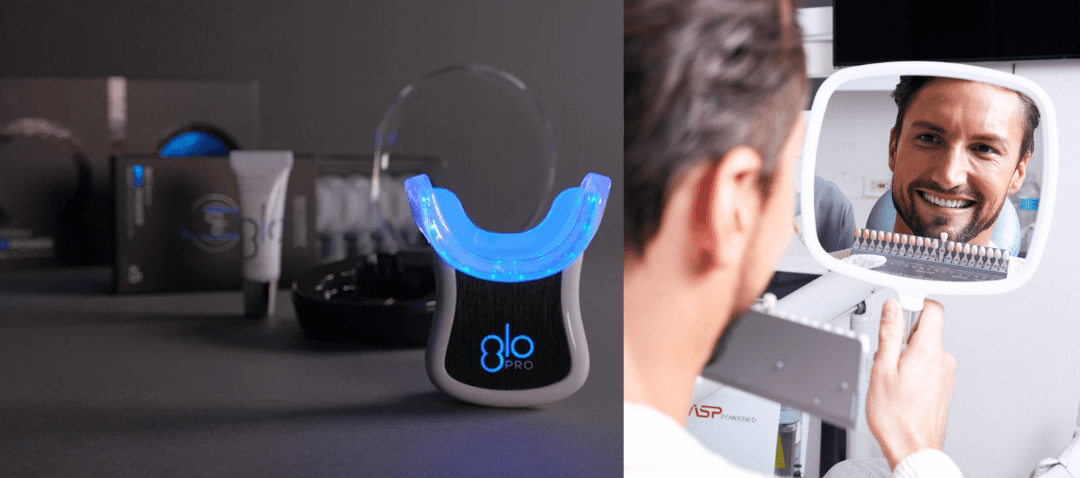
In-office procedures take advantage of high concentration. We treat the teeth with a high-concentration hydrogen peroxide material (typically 24-30%) in a highly controlled environment. We use the GLO Professional whitening system, which applies a specialized warming light to accelerate the reaction process. Because the heat accelerates the breakdown of stains, the treatment time is shorter (under an hour). Less exposure time combined with professional isolation of your gums means faster, dramatic results with minimal sensitivity.
Take-Home Whitening
Take-home whitening relies on exposure time rather than high concentration. We provide you with custom-fit trays designed specifically for your bite. These trays hold a lower concentration whitening gel (like 9% hydrogen peroxide or 10% carbamide peroxide) tightly against the tooth. Because the concentration is lower, you wear the trays for extended periods. This bathes the teeth in the whitening compound, safely lifting stains at your own pace.
The “Dual Whitening” Approach
For the absolute best, longest-lasting results, we often recommend a “dual whitening” system. This dentist-prescribed treatment combines an initial in-office power session to blast away heavy stains, followed by a customized take-home regimen to lock in the final, brilliant shade.
Why Choose Professional Whitening Over OTC?
Over-the-counter (OTC) treatments like strips and generic trays are available everywhere, but they lack professional oversight. OTC products fail for several reasons:
- No Extrinsic Prep: Extrinsic stains and tartar are not professionally removed beforehand, meaning you are often just whitening the plaque on your teeth, not the enamel.
- Low Concentration: The chemical strength is heavily diluted to be sold safely without a license.
- Uneven Application: One-size-fits-all strips risk not applying the compound equally, leading to patchy results.
- Tissue Damage: Without custom trays or a dentist isolating your gums, the bleaching agents easily leak onto your soft tissues, causing chemical burns and severe sensitivity.
- No Diagnosis: Nothing on a pharmacy shelf can tell you whether your discoloration is extrinsic, intrinsic, or a structural defect — and that determines whether whitening can work at all.
Teeth Whitening Maintenance and Touch-Up Treatments
After your treatment, you want to take care of your teeth so your results last. Every whitening patient receives a take-home kit to help keep their teeth bright between visits. Dr. Slate will check your progress during follow-up exams and can provide touch-up treatments when needed. We also offer discounted prices for future in-office whitening treatments to keep your smile refreshed.
To help your teeth stay white longer, drink dark liquids through a straw and maintain rigorous daily brushing and flossing to stop biofilm from forming on the enamel.
Is Teeth Whitening Comfortable?
Patients often experience sensitivity after OTC whitening because of leakage onto the gums, improper use of heat, or the acidic byproducts left behind by cheap gels. Dr. Slate ensures that your in-office treatment is incredibly comfortable.
By using the GLO Professional system and meticulously isolating your gums, lips, and root surfaces, we prevent the high-concentration peroxide from touching anything but your enamel. If you are naturally prone to sensitivity, Dr. Slate will customize your treatment plan, adjusting the concentration and exposure time to ensure a pain-free experience.
Teeth Whitening FAQ
How does teeth whitening actually work?
Peroxide diffuses through the enamel and breaks the chemical bonds of pigment molecules embedded in the tooth structure. Those fragments no longer absorb light the same way, so the tooth appears lighter. The two variables that control the outcome are the concentration of the gel and how long it stays in contact with the tooth. Our full explanation of the science covers the chemistry in more depth.
Why did whitening strips leave my teeth blotchy?
Usually one of three reasons: the strips could not conform to your tooth shape so the gel contacted unevenly, extrinsic stain and tartar were never removed first so you whitened the film rather than the enamel, or you have structural enamel defects that whitening made more visible instead of less.
How white can my teeth realistically get?
That depends on your starting shade, the thickness of your enamel, and whether the discoloration is extrinsic or intrinsic. We record your baseline shade at the evaluation and give you a realistic target before you commit to anything. Teeth with deep tetracycline banding respond far less predictably than teeth with coffee staining.
Does whitening damage enamel?
Professionally supervised whitening at appropriate concentrations does not measurably weaken enamel. The risks come from unsupervised use — excessive exposure time, gel contact with soft tissue, and acidic formulations without remineralizing support.
Will whitening work on crowns, veneers, or bonding?
No. Peroxide has no effect on ceramic or composite restorations. If you have existing restorations in your smile zone, we whiten first, allow the shade to stabilize, and then match new restorations to your final color — never the reverse.
Professional Whitening for Northwest Washington, DC
Located in Foxhall Square on New Mexico Avenue NW, Slate Dental provides concierge cosmetic care to patients throughout Wesley Heights, Spring Valley, The Palisades, American University Park, Cathedral Heights, Georgetown, Forest Hills, Chevy Chase, and Bethesda. As a Washingtonian Top Dentist, Dr. Slate approaches whitening the same way he approaches everything else: diagnose the actual cause first, then select the most conservative treatment that will solve it.
The Slate Dental Whitening Protocol
Reveal Your Brightest Smile
Ready for a brighter, more confident smile? Experience safe, professional teeth whitening customized to your unique biology.
Call our Washington, DC office today at 202-686-5222 or book your appointment online to get started.
Verify Dr. Slate’s status on the official Washingtonian Top Dentist Directory & Bethesda Magazine Top Dentist Directory