
Worn teeth and bite collapse happen when acid softens the enamel and grinding wears it away, faster than the teeth can withstand. The back teeth lose height first, the bite closes, and the front teeth begin carrying forces they were never built for, so they chip, shorten, and flatten. Treatment rebuilds the worn teeth to a natural length and shape, usually starting with the lower arch and opening the bite only as much as the new restorations need. Every case is designed in a laboratory and worn in temporaries for several weeks before anything is finalized. At Slate Dental in Northwest Washington, DC, Dr. John Slate also identifies the source of the acid and protects the finished work with a custom occlusal splint, because rebuilding the teeth without addressing the cause only starts the cycle again.
Signs your teeth are wearing faster than they should
The most recognizable sign is front teeth that have gone flat. Edges that were once gently scalloped become straight and squared off, and the teeth look shorter than they do in older photos. Many people notice it first in pictures, or when a friend comments that their smile looks different. Other signs we often see include:
- Front teeth that look shorter, flatter, or more “even” than they used to
- Chips or thin, see-through edges on the front teeth
- Back teeth with shallow cups or yellow patches where enamel has worn through to the darker layer beneath
- Fillings that seem to stand up above the surface of the tooth around them
- Sensitivity to cold, sweets, or acidic foods
- A lower face that looks shorter, or lips that seem to fold inward
- Grinding or clenching, often noticed by a partner, or a sore jaw on waking
Tooth wear is gradual, which is why it is so easy to miss. Enamel does not grow back, so wear that goes unaddressed keeps compounding, and each year leaves less natural tooth to work with.
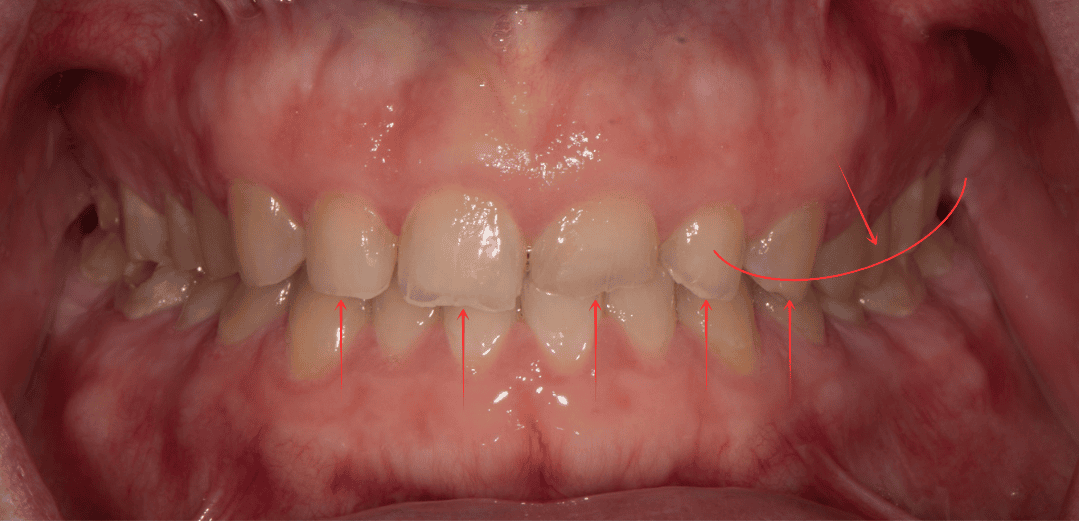
Real patient: the front teeth have worn flat, and the chewing plane on one side has shifted as worn teeth and their neighbors have moved.
Why teeth wear down: acid and grinding working together
Two forces are usually at work. The first is erosion: acid that softens the surface of the enamel. The second is attrition: tooth grinding against tooth, which scrapes that softened surface away. Either one alone wears teeth slowly. Together, they can wear teeth remarkably fast, because the acid keeps the enamel weak while the bite keeps removing it. Of the two, acid is usually the accelerant. Enamel that acid has softened wears away far more easily under chewing, grinding, and even brushing, and the pattern of wear on the teeth often reveals where the acid is coming from (Abrahamsen, International Dental Journal, 2005).
Common sources of acid include citrus fruits and juices, soft drinks, flavored sparkling water, sports and energy drinks, wine, and frequent sipping or snacking throughout the day. Acid can also come from within. Both acid reflux and “silent” reflux, which can cause no heartburn at all, are significantly associated with dental erosion in adults (systematic review, Digestive Diseases and Sciences, 2025). A dry mouth makes everything worse, because saliva is the mouth’s natural buffer against acid. Part of our evaluation is working out which of these is at play for you, and when the source is medical, we encourage you to involve your physician.
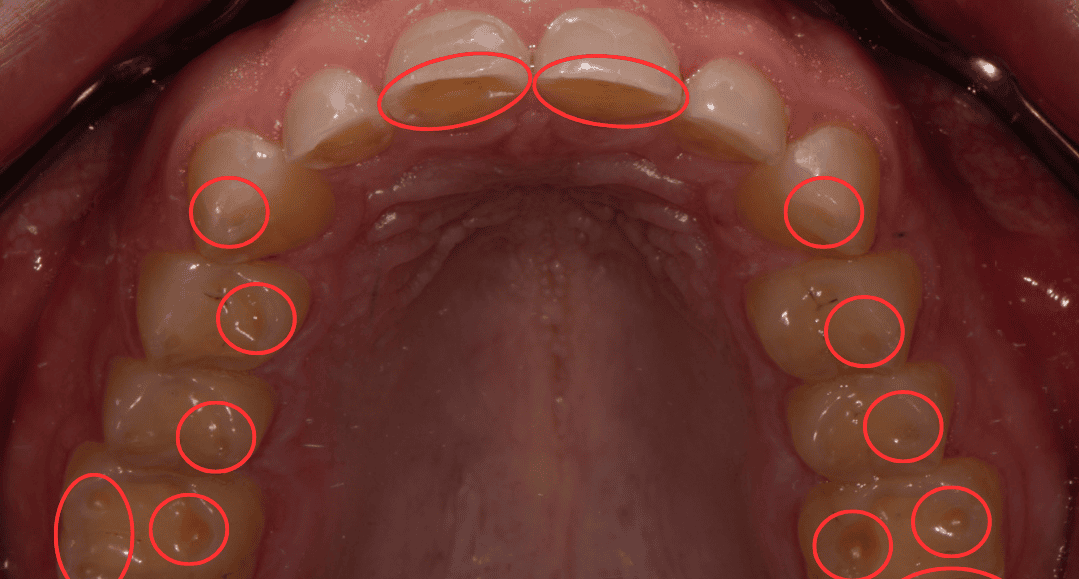
Real patient: small cupped pits on the premolars and molars are often the first visible sign of acid erosion, appearing before the front teeth look noticeably worn.
How a bite collapses: the cycle of wear
Your back teeth do more than chew. They hold your jaws at a specific distance from each other. Dentists call this the vertical dimension of occlusion, which is essentially the height of your bite, propped up by your teeth.
When acid and grinding wear down the chewing surfaces of the back teeth, that height is gradually lost. As the bite closes, the front teeth begin to take on forces that the back teeth used to absorb. The front teeth are built for precision, not for heavy load, so they chip and wear, and they flatten. As the front teeth lose length, the back teeth lose more of their protection and keep wearing too. And all the while, acid continues to wash away the surfaces of every tooth.
That is the cycle: back-teeth wear leads to front-teeth wear, which leads to more back-teeth wear, accelerated by acid at every step. The body does try to compensate. Worn teeth can slowly erupt to keep the bite at its original height, but when acid and grinding remove tooth faster than that process can keep up, the bite closes (review, Clinical, Cosmetic and Investigational Dentistry, 2024). Once that happens, the cycle rarely stops on its own. This is also why simply bonding the front edges back to length often fails. If the bite that wore them down has not changed, the new edges meet the same forces.
What tooth wear looks like up close
Acid erosion and grinding leave recognizable marks. On the front teeth, the biting edges flatten, thin, and chip. On the back teeth, the chewing surfaces develop shallow, scooped-out “cups” where the enamel has worn through to the softer, yellower dentin beneath. Dentin is much softer than enamel, so once it is exposed it erodes and wears faster, and the cups deepen and widen year after year.
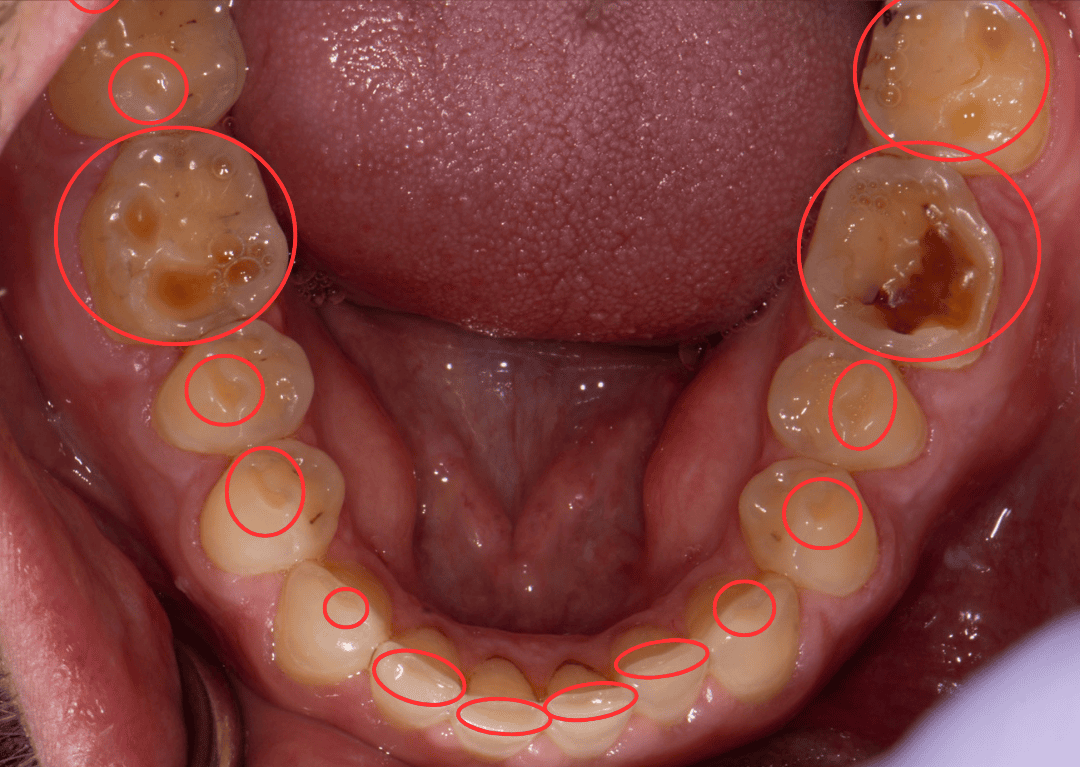
Real patient: the circled areas show deep cupping on the lower molars, where acid has dissolved through the enamel into softer dentin, and flattened front edges. This patient had frequent daily exposure to an acidic drink.
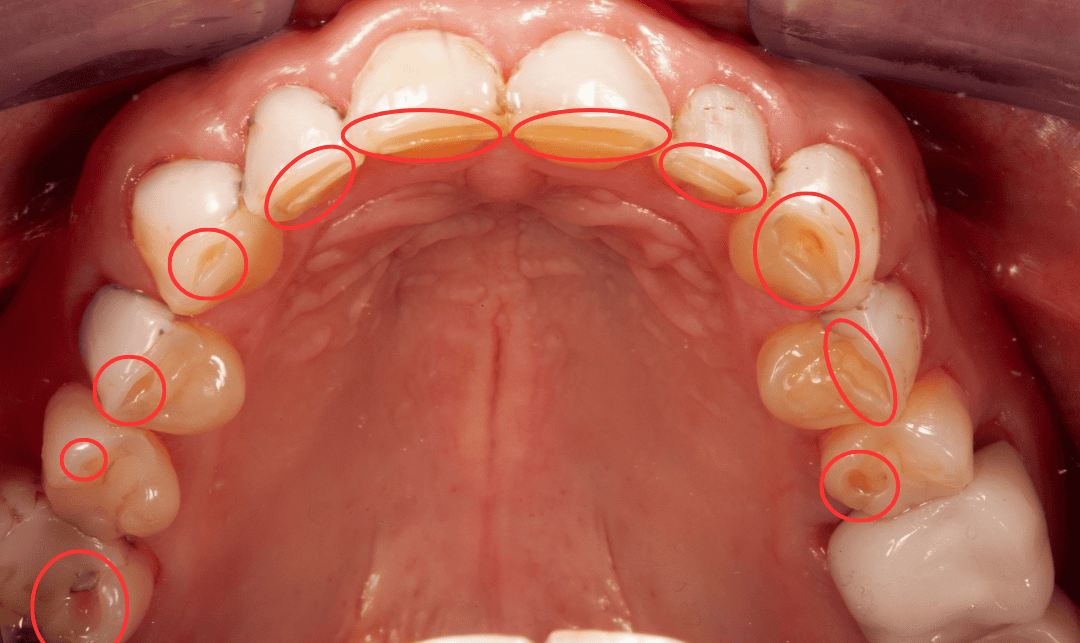
Real patient: the front teeth have worn flat and thin along their biting edges, and the premolars show cupped surfaces with exposed dentin.
Why repairing one tooth at a time often falls short
When worn teeth chip, the usual response is to repair each tooth on its own, within the limits of the bite as it already is. In a mouth that is still wearing, those repairs face the same acid and the same forces as the teeth they replaced, which is why bonding on worn front teeth so often chips, stains, and breaks down at the edges. Over time, teeth can also drift and over-erupt into the space left above a worn tooth, tilting the bite further out of balance. A lasting result usually means planning the whole bite together: the level of the back teeth, and the length, shape, and guidance of the canines and front teeth.
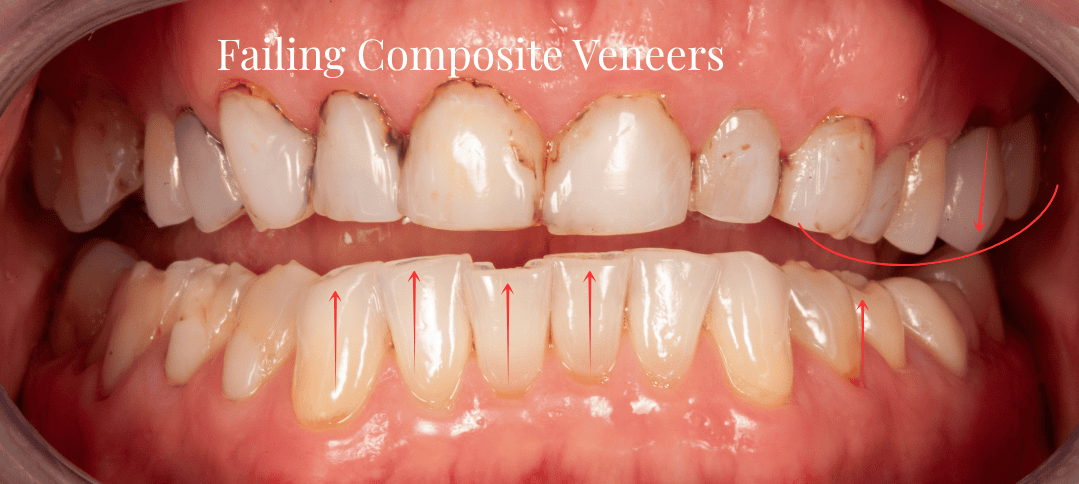
Real patient: composite bonding placed on worn upper front teeth has stained and broken down at the edges, while the lower front teeth continue to flatten. Repairs placed into a worn bite face the same acid and forces as the teeth they replaced.
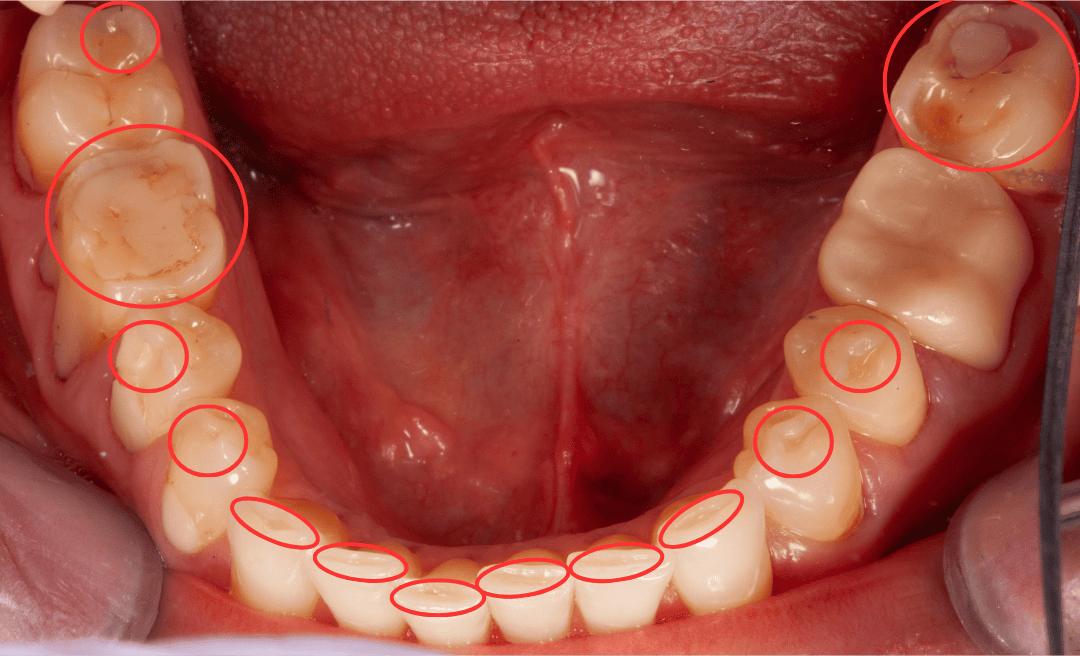
Real patient: a molar here was restored one tooth at a time, at the height of the already-worn bite, while wear continued on the teeth around it.
What happens if worn teeth are left alone
Wear rarely stops on its own. Without treatment, front teeth tend to keep flattening and shortening. Back teeth weakened by deep cupping can crack or fracture, sometimes beyond repair, and exposed dentin can make teeth sensitive to hot and cold. When wear or a fracture reaches the nerve, a tooth may need root canal treatment, or in some cases extraction. Treating sooner usually means more of your natural teeth can be preserved.
The curtains and the stage: why worn teeth change a smile
I often describe a smile as a stage, with your lips as the curtains. When you smile, the curtains open and reveal the stage: your teeth, and the gum tissue that frames them. As teeth wear and the bite closes, the level of that stage shifts behind the curtains. Your upper front teeth may show less when your lips are relaxed, the edges no longer follow the curve of your lower lip, and the smile can start to look older than you feel.
Rebuilding a worn smile means restoring that stage to the right height, and that height is not chosen for appearance alone. The teeth, the gum tissue and its natural scalloped architecture, the bone, and the ligaments that attach each tooth to the jaw all have to be in harmony and in balance, so that the result looks natural and lasts.
How we rebuild a worn bite
Not every worn tooth needs to be restored. When wear is mild, the right first steps are finding the cause, reducing acid exposure, protecting the teeth, and monitoring, and when restoration is needed, a conservative, minimally invasive approach is the recommended standard (European consensus statement on severe tooth wear, Journal of Adhesive Dentistry, 2017).
When a bite has collapsed, treatment usually involves opening the bite slightly, and only as much as the restorations need. The goal is not a particular bite height for its own sake. The added space lets worn teeth be rebuilt to a natural length and shape without removing more healthy tooth to make room. How much the bite is opened, and which teeth need restoration, is determined in planning rather than decided at the outset. Depending on what each tooth needs, the restorations may include ceramic onlays and crowns on the back teeth and porcelain veneers or crowns on the front teeth, always choosing the most conservative restoration the bite can support.
Why we often start with the lower arch
We often recommend designing and restoring the lower arch first. The lower teeth sit slightly inside the upper teeth, closer to the tongue, so they form the foundation that the upper teeth close against. If we design the lower arch correctly, with the final appearance of the upper arch already in mind, we know both what the supporting biology can accommodate and how the upper smile will look when it is complete. Building from the foundation up, rather than starting with the most visible teeth, is what lets the two arches finish in balance.
Designed in the laboratory first
Before any treatment begins, your case is designed in a laboratory setting, working from detailed records of your teeth, your bite, and your smile. That design sets the length and shape of the teeth, how they work together when you chew and speak, and how they relate to your lips and gum line, so the plan is complete on paper before it touches a tooth.
Lived in before anything is final
We place temporary restorations on each arch before finalizing treatment, and you wear them for about three weeks. That time lets you live with your new smile, eating, speaking, and seeing yourself in photographs, and tell us what you like and what you would change about the shape, form, and function of your teeth. Adjustments happen here, while they are easy, and the final restorations are made to match the temporaries you have approved.
Protecting the result
Grinding and clenching cannot always be prevented, especially when they happen during sleep. So once both arches have been restored, we recommend an occlusal splint, a custom appliance that controls your biting forces and keeps your new restorations from grinding against each other. Rebuilding worn teeth is a significant investment, and the splint is how you protect it. Sleep grinding is associated with a higher failure rate for porcelain veneers in particular (systematic review, Journal of Prosthetic Dentistry, 2018). You can read more about the differences between appliances on our custom mouthguards and night guards page.
Our approach: biology first
Dr. Slate completed advanced clinical training through the Strupp-Brumm Seminars, taught by Dr. William C. Strupp, Jr. and Dr. Michael W. Brumm, both Accredited Fellows of the American Academy of Cosmetic Dentistry. That training is built on a clear order of priorities: the bone, the gum tissue, and the living tooth are protected first, and the restoration is designed to serve them, not the other way around. For a worn dentition, that means a healthy gum foundation before restorative work begins, conservative preparation that preserves as much natural tooth as possible, and a bite designed around what your supporting structures can sustain for the long term. Slate Dental is a general dentistry practice. When a case benefits from orthodontics, periodontal care, or surgery, Dr. Slate will say so and coordinate with trusted specialists.
What to expect, step by step
- Comprehensive evaluation. Records of your teeth, gums, bite, and jaw joints, photographs and radiographs, and a conversation about what you have noticed and what you would like to change.
- Finding the cause. Identifying the sources of acid and the grinding or clenching pattern behind the wear, so they can be addressed before and after treatment.
- Laboratory design. Your new bite and smile are designed from your records, with the lower arch planned around the upper result.
- Temporaries on each arch. You wear them for about three weeks and tell us what you like and what you would change about shape, form, and function.
- Final restorations. The permanent restorations are made to match the temporaries you have approved and placed arch by arch.
- Protection and maintenance. A custom occlusal splint, regular recare visits, and ongoing attention to the acid sources we identified together.
Investment
Rebuilding a worn bite is one of the most involved forms of restorative dentistry, and the investment depends on how many teeth need restoration and what foundational work comes first. We provide a clear, itemized estimate at your consultation, and because treatment proceeds in phases, it can often be planned over a timeline that works for you. Interest-free financing is available for up to six months. Slate Dental is also an in-network provider for Cigna DPPO and PPO plans.
Honest answers about worn teeth and bite collapse
Can worn teeth be fixed without crowning every tooth?
Often, yes. Wear is not always even, and many teeth can be restored with conservative onlays or veneers rather than full crowns. The goal is the most conservative restoration each tooth can support, decided tooth by tooth during planning.
Why not just bond the front teeth back to their original length?
If the back teeth have lost height, the front teeth are taking forces they were not built for, and new edges will meet the same forces that wore down the originals. Bonding can be the right answer for limited, localized wear, but when the bite has collapsed, the bite itself has to be rebuilt for the result to last.
Will my bite feel different?
At first, a little. When the bite is opened slightly to make room for restorations, most people adapt within a week or two, and any muscle tiredness or change in speech is usually mild and short-lived (review, 2024). Your temporaries are in for about three weeks, so you have time to get used to them and tell us what you would change before the final restorations are made.
Is a night guard enough on its own?
A night guard protects teeth from grinding, but it does not restore height or tooth structure that has already been lost, and it does not stop acid erosion. For early wear, a guard and changes to acid exposure may be all you need. For a collapsed bite, the guard is the final step that protects the rebuilt teeth.
What if some of my teeth are missing?
Missing teeth are often part of a collapsed bite, because fewer teeth are left to hold the bite’s height. Where implants are the right choice, a surgical specialist places them and Dr. Slate designs and restores the teeth on top, as part of the same overall plan. Learn more about dental implant restorations.
Is this the same as full mouth reconstruction?
Rebuilding a collapsed bite is one of the most common reasons for full mouth reconstruction. Not every worn smile needs every tooth restored, though. Wear limited to a few front teeth, without bite collapse, can sometimes be treated with a smaller set of veneers.
Can I get a second opinion on a plan I already have?
Yes. Worn-teeth cases can be planned in very different ways, and it is reasonable to want another perspective before committing. Read more about our second-opinion consultations.
Reviewed by Dr. John Slate, DMD, general dentist and owner of Slate Dental, with advanced training in cosmetic and restorative dentistry through the Strupp-Brumm Seminars; member of the American Academy of Cosmetic Dentistry (AACD) since 2020; DMD, Nova Southeastern University; undergraduate, University of Florida; Washingtonian Top Dentist (2021, 2023, 2025); Bethesda Magazine Top Dentist (2024, 2026).
Schedule a worn-teeth consultation in Foxhall Square
If your teeth have been getting shorter, flatter, or more sensitive, the most useful next step is a conversation and a careful look at your bite. We will explain what is causing the wear, what it would take to rebuild, and whether a smaller step makes more sense for now. Slate Dental, 3301 New Mexico Ave NW, Suite 332, Washington, DC 20016, on the third floor of Foxhall Square with covered parking on site. We serve Foxhall, Wesley Heights, Spring Valley, AU Park, Georgetown, Bethesda, and Chevy Chase. Call (202) 686-5222 or request a consultation.
Selected references
- Loomans B, Opdam N, Attin T, et al. Severe tooth wear: European consensus statement on management guidelines. Journal of Adhesive Dentistry. 2017;19(2):111–119. doi:10.3290/j.jad.a38102
- Abrahamsen TC. The worn dentition: pathognomonic patterns of abrasion and erosion. International Dental Journal. 2005;55(4 Suppl 1):268–276. PubMed
- Wang J, Zhou Y, Lei D. Relationship between laryngopharyngeal reflux, gastroesophageal reflux disease, and dental erosion in adult populations: a systematic review. Digestive Diseases and Sciences. 2025;70(3):1078–1090. doi:10.1007/s10620-024-08824-9
- Yadfout A, El Aoud J, Merzouk N, Slaoui Hasnaoui J. Increasing vertical dimension of occlusion (VDO): review. Clinical, Cosmetic and Investigational Dentistry. 2024;16:135–142. doi:10.2147/CCIDE.S453704
- de Souza Melo G, Batistella EÂ, Bertazzo-Silveira E, et al. Association of sleep bruxism with ceramic restoration failure: a systematic review and meta-analysis. Journal of Prosthetic Dentistry. 2018;119(3):354–362. doi:10.1016/j.prosdent.2017.07.005
Medically reviewed by Dr. John Slate, DMD. Last updated October 2026. This page is general educational information, not a diagnosis or a treatment recommendation; individual results vary and depend on your specific clinical situation. Your privacy matters: we never share personal health information, in keeping with our HIPAA Notice of Privacy Practices.